- New


Physics digital laboratory kit
 Privacy Policy
 Delivery policy
 Return policy
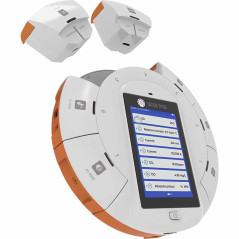
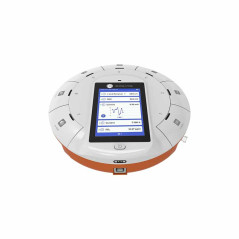
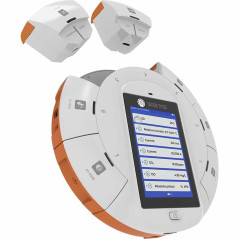
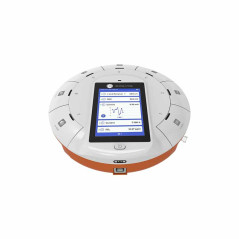
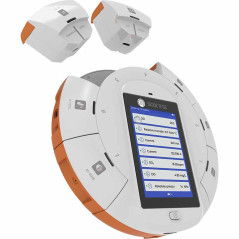
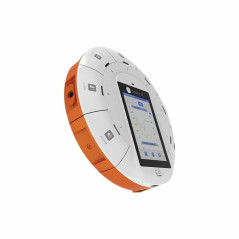
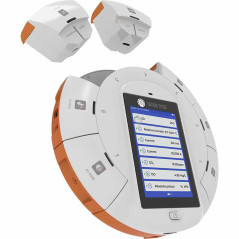
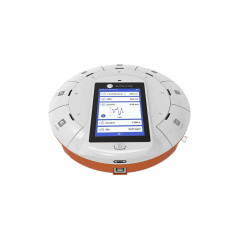
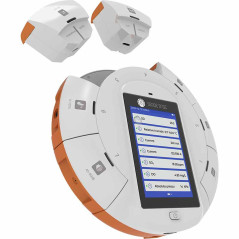
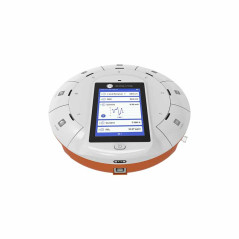
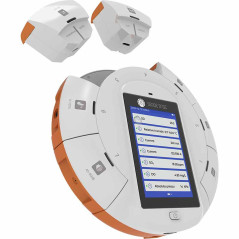
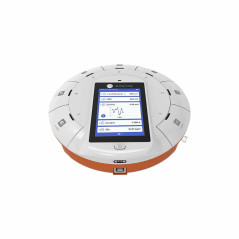
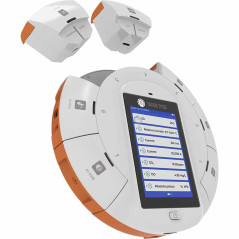
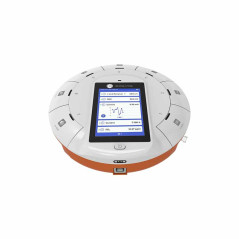
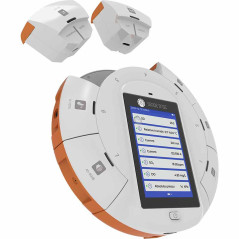
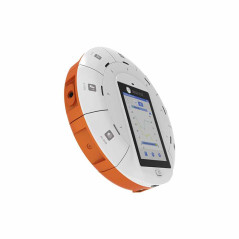
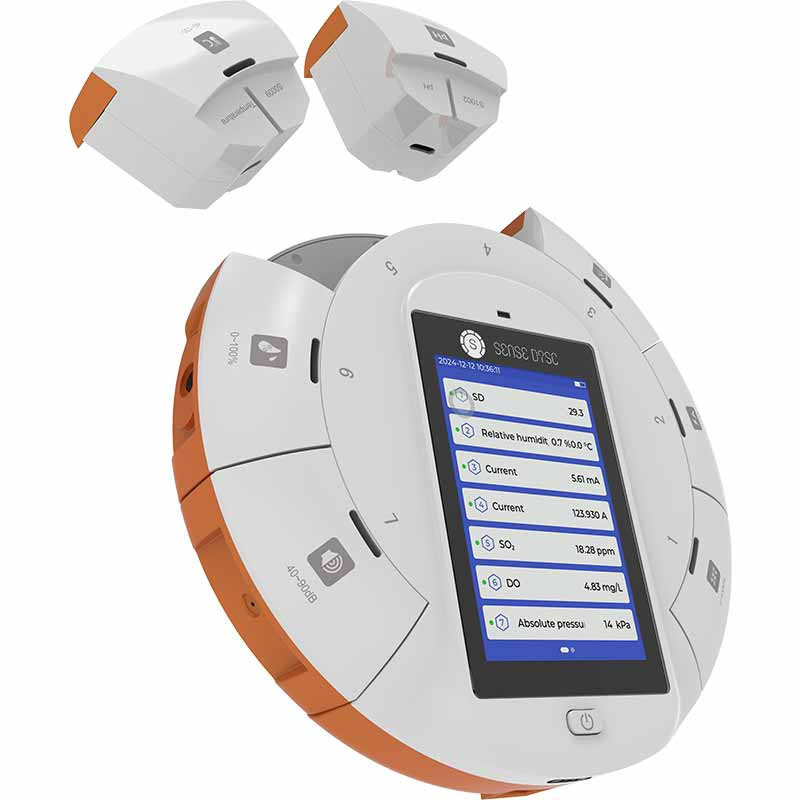
The complete SenseDisc Pro digital laboratory kit for PHYSICS with 33 sensors represents the leading solution for real-time data acquisition, designed to transform traditional physics laboratories into modern environments for experimentation and research.
It covers all fundamental branches of classical and modern physics – mechanics, thermodynamics, electromagnetism, optics, waves, and nuclear physics.
This complete package, based on the digital physics laboratory kit concept, offers teachers and students the ideal tools for high-precision experimental studies.
Through the SenseDisc Pro central unit and the 33 specialized sensors, abstract physical phenomena become instantly visible in the form of real-time graphs.
Thus facilitating a deep understanding of the laws of nature and stimulating analytical thinking in school and university laboratories.
Additionally, for an extended visual representation of physics experiments in front of the class, the SenseDisc Pro device can quickly connect to an interactive display, PC, or laptop, turning every demonstration into an impactful interactive lesson.
Main Advantages Digital Physics Laboratory Kit
Real-Time Scientific Accuracy: High-precision monitoring of mechanical, electrical, or thermodynamic physics experiments, eliminating human errors and approximate values.
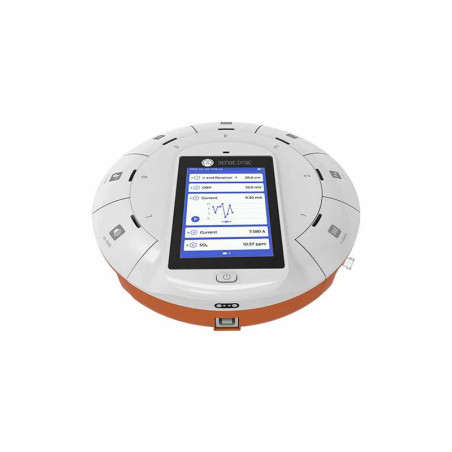
All-in-One Solution for All Branches of Physics: SenseDisc Pro central unit equipped with a touchscreen and an exhaustive package of 33 dedicated sensors that fully cover the school and university physics curriculum.
Dynamic Visualization of Physical Phenomena: Immediate transformation of experimental data into intuitive graphs, essential for validating the fundamental laws of physics in front of students.
Flexibility and Universal Inputs: The ability to connect specialized external sensors for advanced dynamics, forces, pressure variations, and complex circuits.
Extended Connectivity for Modern Education: Multi-platform compatibility and the ability to output directly to an interactive display, PC, or laptop for engaging demonstration lessons.
Technical Specifications Digital Physics Laboratory Kit
1.SenseDisc Pro Base
Total Sensors Available in Physics Kit: 33 sensors (4 integrated in the base + 22 external sensors + 7 sensors for the universal input)
Expansion Ports: 1 free universal input for additional sensors.
Sampling Accuracy: Up to 100,000 samples/second
Screen: 3.5-inch TFT Color Touchscreen (320x240 resolution)
Connectivity: Bluetooth, USB, Wi-Fi
Internal Storage: Integrated flash memory for over 100,000 records
Power Supply: Rechargeable Li-Po battery (operating autonomy > 8 hours)
Analysis Software: iLab (included, with usage license)
OS Compatibility: Windows, macOS, iOS, Android, Linux
2.iLab Data Analysis Software Specifications
Display Modes: Line graph, analog indicator, digital, data table, GPS map
Analysis Functions: Curve fitting (linear, polynomial, exponential), derivation, integration, statistics
Real-Time Processing: Live data sampling and graphical playback from all connected sensors
Data Export: CSV format, Excel, graph image, laboratory project saving
Experiment Settings: Adjustment of sampling frequency, recording duration, and triggers
3.Sensors Integrated in the SenseDisc Pro Base (4 Sensors)
Altimeter: Resolution 0.1 m
Applications: Altitude measurement in field experiments and relief analysis.
Barometer: Range 30-120 kPa, Accuracy 0.1 kPa (relative accuracy 0.006 kPa)
Applications: Monitoring atmospheric pressure and meteorological stages.
Triaxial Accelerometer: Range -8g to +8g | Resolution 0.016g | Accuracy $\pm$2.5%
Applications: Study of 3D motion, vibrations, and gravity.
GPS Sensor: Position accuracy 2.5m CEP50, Speed accuracy 0.1m/s, Max. update rate 10Hz
Applications: Geolocation of data collection points in environmental experiments.
4.External Sensor Package (22 Sensors + 7 Sensors for Universal Input)
1.Voltage Sensor
Usage: Measures voltage in an electrical circuit or apparatus.
Measuring range: -30V~30V
Accuracy: $\pm$1%
Resolution: 0.02V
Resistance: 2MΩ
Experiments: Voltammetric measurement of bulb resistance, observation of capacitor charging and discharging experiments.
2.Millivolt Voltage Sensor
Usage: The millivolt voltage sensor is used to measure the potential difference between two ends of an electrical device.
The millivolt voltage sensor circuit divides the collected voltage after voltage processing, enabling the measurement of weak electromotive force in DC or low-frequency, low-voltage AC circuits.
Measuring range: -500~500mV
Accuracy: ±1%
Resolution: 0.3mV
Input impedance: 500kΩ.
Usage: High-precision measurement of small electrical potential differences in sensitive electronic circuits, electrochemistry experiments (galvanic cell emf), and thermocouples.
3.Micro-Voltage Sensor
Usage: The micro-voltage sensor is used to measure voltage in the range of -60mV to 60mV. It amplifies the input voltage to measure voltage at the micro level.
Measuring range: -60~60mV
Accuracy: ±1%
Resolution: 0.03mV
4.Current Sensor
Usage: Measures current in a circuit.
Measuring range: -1A~1A
Accuracy: ±1%
Resolution: 0.001A
Resistance: 0.22Ω
Typical experiments: Current-limiting method used to plot the volt-ampere characteristic curve of small bulbs, relationship between output power and load, etc.
5.Micro-Current Sensor
Usage: Measures micro-current in a circuit.
Measuring range: -10μA~10μA
Accuracy: ±1%
Resolution: 0.01μA
Internal resistance: 0.22Ω
Typical experiment: Induced current generation, geomagnetic field generator, and other experiments.
6.Milli-Current Sensor
Usage: The milli-ampere sensor is used to measure current in the range of -20 to 20mA in a circuit.
When current passes through a resistor, it forms a small electrical potential difference at both ends of the resistor.
After amplification through the circuit, it can accurately measure the current in the circuit.
Measuring range: -20~20mA
Accuracy: ±1%
Resolution: 0.01mA
7.Charge Sensor
Usage: To measure the quantity of electricity of a charged body.
Measuring range: -220nC~220nC
Accuracy: 4.4nC
Resolution: 0.1nC
Typical experiments: Electrostatic induction, electrostatic shielding, charge properties of charged objects, etc.
8.Temperature Sensor
Usage: Measures temperature.
Measuring range: -40°C to 135°C
Accuracy: ±0.6°C
Resolution: 0.1°C
Experiments regarding heat absorption and dissipation, study of boiling and freezing points, thermodynamic chemical reactions, and Joule's law.
9.Rapid Temperature Sensor
Usage: Measurement of object surface temperature, gases, as well as non-corrosive acidic and alkaline liquids.
Measuring range: -25°C ~ 100°C
Accuracy: ±0.8°C
Resolution: 0.1°C
Typical experiment: Compressed gas work experiment, Charles's law experiment, water freezing and ice melting experiment, etc.
10.Surface Temperature Sensor
Usage: Measurement of object surface temperature, gases, as well as non-corrosive acidic and alkaline liquids.
Measuring range: -30°C ~ 150°C
Accuracy: ±0.8°C
Resolution: 0.1°C
Typical experiment: Comparison of thermal conductivity of different substances.
11.Thermocouple Sensor
Usage: To measure surface temperature, gas temperature, acidic and alkaline liquids, and can also be used for very low and high temperature measurements.
Measuring range: -200°C ~ 1200°C
Accuracy: ±3°C
Resolution: 0.25°C
Typical experiments: Exploring the temperature of different parts of an alcohol lamp flame, exploring the law of temperature change during solid melting, and other experiments.
12.Motion Sensor
Usage: Used to measure the displacement of an object's motion.
Measuring range: 20 cm ~ 600 cm
Accuracy: ±2%
Resolution: 0.1 cm
Typical experiment: Exploring uniform linear motion speed, using the motion sensor to measure car movement speed, etc.
13.Light Sensor
Usage: Measures the light intensity value in the measured environment.
Measuring range: 0~55000Lux
Accuracy: ±5%
Resolution: 15 Lux
Used for sensitive, precise, and rapid measurement of ambient light intensity. Typical experiments: Exploring the relationship between illumination and distance (inverse-square law in optics) and the study of photosynthesis.
14.Magnetic Field Sensor
Usage: Measurement of magnetic field intensity.
Measuring range: -64mT~64mT
Accuracy: ±3%
Resolution: 0.04mT
Usage: Study of uniform magnetic fields, verification of the direction of a circular current's magnetic field, and other experiments.
15.Sound Level Sensor (Sound Level Meter)
Usage: The sound level sensor can measure sound intensity. It collects the sound signal using an electret microphone. After circuit amplification, it can display the maximum sound intensity value.
Measuring range: 40dB to 92dB
Accuracy: ±4dB
Resolution: 0.1dB
Usage: Sound synthesis, ambient noise measurement, sound intensity level measurements, and other related experiments.
16.Radiation Monitor (Geiger-Muller Sensor)
Usage: The S0022 G-M sensor is used for radioactivity experimentation studies.
It is primarily used to measure the intensity of gamma (γ) and beta (β) rays.
Measuring range: 0 ~ 40000 c/min
Accuracy: ±2%F.S
Resolution: 1 c/min
17.Absolute Pressure Sensor
Usage: Measurement of gas pressure in an atmospheric environment or a closed space.
Measuring range: 0~400kPa
Accuracy: ±2%
Resolution: 0.1kPa
Used to measure the absolute pressure of a gas in an atmospheric environment or closed space.
Typical experiments: Measurement of atmospheric pressure, chemical reactions of metals with hydrochloric and dilute sulfuric acids.
Compression ignition device experiments, study of water boiling and pressure-temperature relationship.
18.Microphone (Sound Level Sensor)
Usage: The microphone collects the sound signal using an electret microphone.
Measuring range: 100 Hz ~ 15 kHz
Typical experiments: Resonance, reflection, and absorption of sound, etc.
19.Current Sensor
Usage: Measures current in a circuit.
Measuring range: -10A~10A
Accuracy: ±2%
Resolution: 0.01A
20.Current Sensor
Usage: Measures current in a circuit.
Measuring range: -30A ~ +30A
Accuracy: ±2%
Resolution: 0.02A
Usage: Measurement of electric current intensity in complex DC and AC circuits with high amperage values.
21.Voltage Sensor
Measuring range: -500V~500V
Accuracy: ±2%
Resolution: 0.3V
22.Frequency Sensor
Usage: Frequency sensors are used to measure the frequency of an alternating current (waveform).
It can be adapted to a wide range of scenarios.
The AC voltage signal is converted into a standard TTL square wave through an internal high-resistance buffer and high-speed gate circuit, and counted by an internal timer counter to convert frequency.
Measuring range: 1Hz~8MHz
Accuracy: ±1%
Resolution: 1Hz
Typical experiment: Measurement of AC current frequency
The 7 Universal Sensors That Can Be Connected Separately to the Free Universal Input
1.Force Sensor
Usage: To measure tension or pressure.
Measuring range: -50N~50N
Accuracy: ±1%
Resolution: 0.03N
Typical experiments: Experiments such as estimating atmospheric pressure, relationship between action force and reaction force, etc.
2.Photogate Sensor
Measuring range: 0~∞s
Accuracy: ±1μs
Resolution: 1μs
Usage: Verifying the law of conservation of momentum; using optoelectronic gates to explore the relationship between acceleration, force, and mass.
3.Relative Pressure Sensor
Usage: To measure the pressure difference between the gas in the atmospheric environment and the measured space.
Measuring range: -20kPa ~ 20kPa
Accuracy: ±5%
Resolution: 0.01kPa
Typical experiments: Relationship between fluid pressure and flow rate, etc.
4.Motion Transmitter and Receiver Sensor
Usage: The motion transmitter and receiver sensor is divided into two parts (transmitter and receiver);
The working principle is: within a very short time, the light transmission time can be considered as 0.
The transmitter first transmits infrared light signals to inform the receiver to transmit ultrasonic signals at the start time and emits ultrasonic waves.
The receiver receives the light signals to record the start time and times until the ultrasonic signals are received.
Finally, according to the formula distance = sound speed × time, the distance between the generator and the receiver is calculated.
The transmitter's driving circuit first provides a narrow voltage pulse to the piezoelectric element.
Under the action of this pulse, the piezoelectric element starts to oscillate and emits ultrasonic pulses outward, while the transmitter uses a light source to inform the receiver to start timing.
When the receiver receives the pulse, the time (T) used by the transmitter from pulse emission to reception by the receiver is calculated.
There is a screw hole (M6 thread) on the side of the sensor, which can be used to fix the sensor on a suitable device.
Measuring range: 0~2m
Accuracy: ±2%F.S
Resolution: 1mm
5.Distance Sensor
The distance sensor consists of two parts: transmitter and receiver.
The operating principle is that the propagation speed of light is much faster than that of sound waves.
Therefore, it can be assumed that the light propagation time is 0.
The transmitter sends an infrared light signal to inform the receiver about the start time of the ultrasonic wave and sends the ultrasonic wave.
The receiver receives the light signal, starts recording the start time, and counts until it receives the ultrasonic signal, thus calculating the time used for ultrasonic propagation.
Finally, according to the formula "distance = speed × time", the distance between transmitter and receiver is calculated.
There is a screw hole (M6 thread) on the side of the distance sensor, which can be used to fix the sensor on a suitable device.
Measuring range: 5cm~400cm
Accuracy: 1cm or 2% F.S
Resolution: 0.1cm
6.Multi-Range Voltage Sensor
Usage: To measure voltage in electrical circuits and devices.
It features a three-range selection switch, allowing you to switch measurement ranges with a single click based on experimental requirements.
Scale 1
Measuring range: -300mV to 300mV
Accuracy: ±1%
Resolution: 0.2mV
Internal resistance: >1MΩ
Scale 2
Measuring range: -3V to 3V
Accuracy: ±1%
Resolution: 0.001V
Internal resistance: >40kΩ
Scale 3
Measuring range: -30V to 30V
Accuracy: ±1%
Resolution: 0.02V
Internal resistance: >40kΩ
Typical experiments: Exploring the relationship between the voltage across an electrical device and the voltage of a power source in series and parallel circuits, measuring the resistance of a bulb using the volt-ampere method.
Observing capacitor charging and discharging, studying the volt-ampere characteristic curve, measuring metal resistivity using the volt-ampere method, and measuring electromotive force and internal resistance of batteries and power sources.
7.Multi-Range Current Sensor
Usage: To measure current in a circuit.
It features a three-range selection switch, allowing you to switch measurement ranges with a single click based on experimental requirements.
Scale 1
Measuring range: -20mA to 20mA
Accuracy: ±1%
Resolution: 0.01mA
Internal resistance: 5.1Ω
Scale 2
Measuring range: -200mA to 200mA
Accuracy: ±1%
Resolution: 0.1mA
Resistance: 500mΩ
Scale 3
Measuring range: -2A to 2A
Accuracy: ±1%
Resolution: 0.001A
Internal resistance: 50mΩ
Usage Scenarios Digital Physics Laboratory Kit
1.Study of Electricity and Electromagnetism
Investigating Ohm's Law over extended ranges: Using voltage and current sensors (including multi-range and micro-ampere variants) to plot the current-voltage characteristic.
For various circuit elements (resistors, diodes, miniature bulbs).
Data is acquired simultaneously and represented graphically in real-time on the touchscreen or interactive display.
Analysis of Alternating Current (AC) Circuits and Frequency: Connecting the frequency sensor and dedicated inputs to study phase shifts, waveforms, and the behavior of inductors and capacitors in low-voltage alternating current circuits.
Study of Electric Charge: Quantitative measurement of electric charge accumulated in capacitors or generated via triboelectric effect, providing students with a concrete understanding of abstract electrostatic magnitudes.
2.Thermodynamics and Heat Study
Monitoring rapid thermal variations: Using the rapid temperature sensor and thermocouple to record sudden temperature changes, such as the rapid cooling/heating process of a body or endothermic/exothermic reactions in solutions.
Thermal Equilibrium and Heat Transfer: Real-time tracking of thermal transfer curves between two volumes of water at different temperatures, experimentally validating the principle of thermal equilibrium and calorimetric balance.
Surface Temperature Analysis: Analysis of thermal distribution on various materials (metals, insulators) during local heating, using the specialized surface sensor.
3.Mechanics and Physical Dynamics
Study of rectilinear motion and acceleration: Using the motion sensor (ultrasonic or infrared) and carts on an air/mechanical track for the instantaneous determination of position, velocity, and acceleration of a body in free fall or on an inclined plane.
Analysis of Contact Forces and Oscillation Dynamics: Using the high-sensitivity force transducer and optical barriers (Photogate) to study the elastic pendulum, gravitational pendulum, and Hooke's law, eliminating manual timing errors.
Measurement of Distance and Kinematic Parameters: Precise evaluation of complex trajectories using the motion sensor transmitter and receiver set.
4.Modern Physics, Optics, and Environmental Study
Monitoring Nuclear Radiation Background: Using the Geiger-Muller detector included in the package for safety and environmental demonstration experiments, measuring the natural radiation background or the activity of certified educational sources.
Acoustics and Sound Wave Study: Using the sound meter and high-precision microphone, students can visualize acoustic waveforms, analyze the frequencies of sounds emitted by tuning forks or musical instruments, and study interference and resonance phenomena.
Magnetic Field Measurements: Investigating magnetic induction around solenoids and current-carrying conductors, directly connecting electromagnetism theory to rigorous experimental measurements.
Kit Contents Digital Physics Laboratory Kit
Consola Datalogger SenseDisc Pro (with 4 integrated sensors: Altimeter, Barometer, Triaxial Accelerometer, GPS)
USB data and charging cable
Power adapter
1.Voltage Sensor
2.Millivolt Voltage Sensor
3.Micro-Voltage Sensor
4.Current Sensor
5.Micro-Current Sensor
6.Milli-Current Sensor
7.Charge Sensor
8.Temperature Sensor
9.Rapid Temperature Sensor
10.Surface Temperature Sensor
11.Thermocouple Sensor
12.Motion Sensor
13.Light Sensor
14.Magnetic Field Sensor
15.Sound Level Sensor (Sound Meter)
16.Radiation Monitor (Geiger-Muller)
17.Absolute Pressure Sensor
18.Microphone (Sound Level Sensor)
19.Current Sensor
20.Current Sensor
21.Voltage Sensor
22.Frequency Sensor
23.Force Sensor
24.Photogate Sensor
25.Relative Pressure Sensor
26.Motion Transmitter and Receiver Sensor
27.Distance Sensor
28.Multi-Range Voltage Sensor
29.Multi-Range Current Sensor
Specific References
No customer reviews for the moment.
Physics digital laboratory kit