- New


Astronomy digital laboratory kit
 Privacy Policy
 Delivery policy
 Return policy
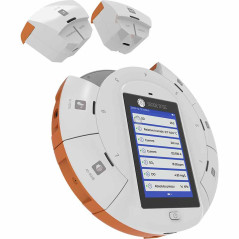
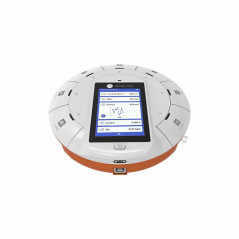
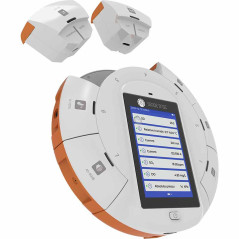
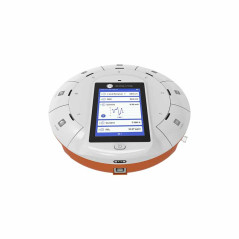
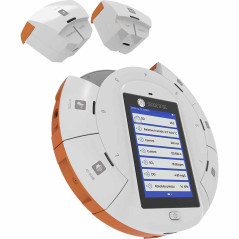
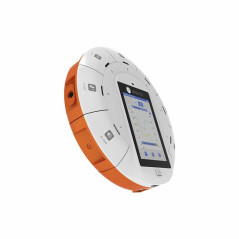
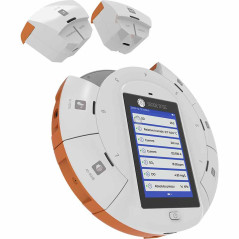
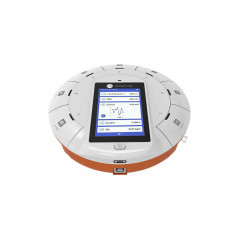
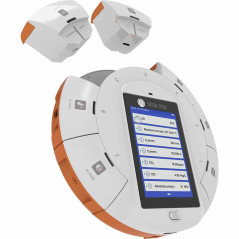
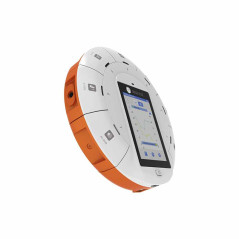
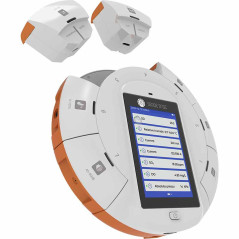
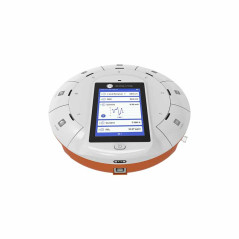
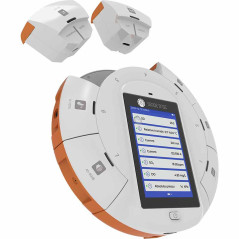
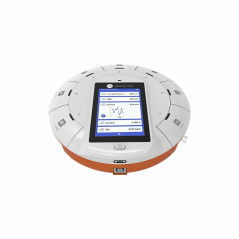
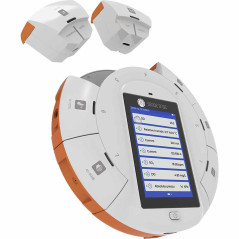
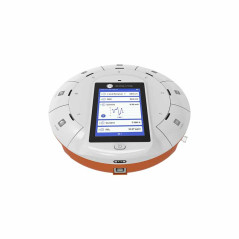
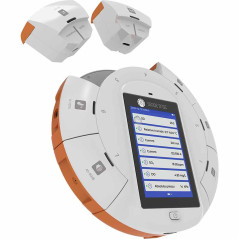
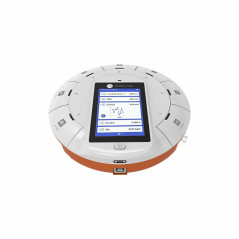
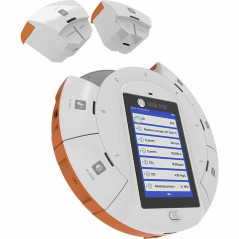
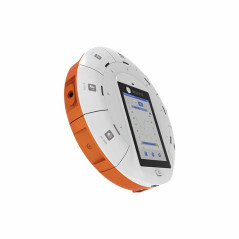
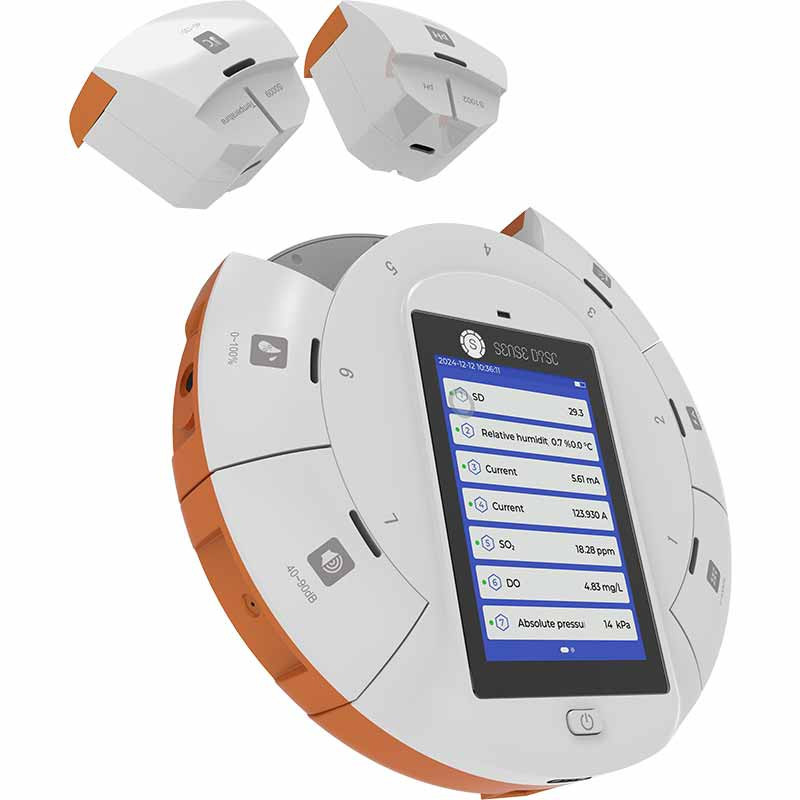
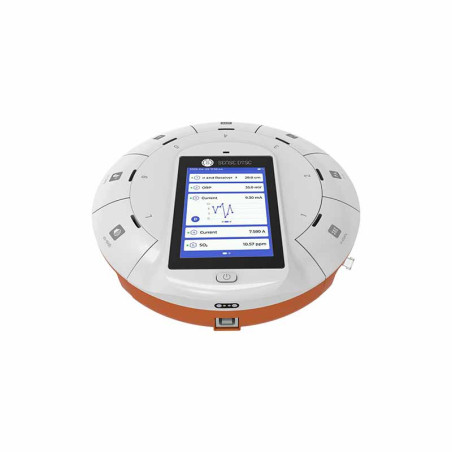
Complete SenseDisc Pro Digital Laboratory Kit for ASTRONOMY (19 sensors) is the advanced solution specifically designed for the hands-on exploration of astronomy, astrophysics, solar physics, and space environmental science.
Centered around an autonomous datalogger console and equipped with an extensive package of 19 sensors, this Astronomy digital laboratory kit allows middle and high school students to conduct real scientific experiments, transforming theoretical astronomical observations into measurable, real-time data analysis.
The kit enables the quantification of phenomena invisible to the naked eye: from background cosmic radiation flux and the interaction of the solar wind with Earth's magnetosphere, to the Sun's spectral radiation and atmospheric composition.
Additionally, for an expanded visual presentation of physics experiments in front of the classroom, the SenseDisc Pro device can be quickly connected to an interactive display, PC, or laptop, turning every demonstration into a high-impact interactive lesson.
Main Advantages of the Astronomy Digital Laboratory Kit
Experimental Investigation of Astrophysics and Solar Physics:
Goes beyond simple visual observation through a telescope by enabling the direct measurement of invisible cosmic phenomena. Using the Geiger-Muller radiation monitor and UV sensor, students can quantify secondary cosmic radiation flux, solar radiation intensity, and its attenuation through the atmospheric layer.
Sky Quality Analysis (Astronomical Seeing) and Light Pollution:
Provides the necessary tools for a rigorous evaluation of night observation conditions. Sensors for light, barometric pressure, temperature, and humidity allow the measurement of sky background brightness (light pollution detection) and the determination of optimal atmospheric stability for astronomy sessions.
Progressive Simulations of Astrobiology and Planetary Conditions:
Facilitates the modeling of environments and atmospheres of other celestial bodies (such as Mars or Venus). Using gas sensors (CO2, O2), soil temperature, and moisture sensors, students can analyze the greenhouse effect, planetary regolith characteristics, and habitability/survival conditions in space.
Real-Time Study of Geomagnetism and Solar Interaction:
Enables mapping and monitoring of Earth's magnetic field using the dedicated sensor. The system helps students understand magnetosphere dynamics, how it protects the planet against solar wind, and the effects of geomagnetic storms on terrestrial grids.
Technical Specifications of the Astronomy Digital Laboratory Kit
1. SenseDisc Pro Base Unit
Total Sensors Available in the Astronomy Digital Laboratory Kit: 19 sensors (4 integrated in the base + 11 external sensors + 4 sensors for the universal input)
Expansion Ports: 1 free universal input for additional external sensors
Sampling Accuracy: Up to 100,000 samples/second
Display: 3.5-inch Color TFT Touchscreen (320x240 resolution)
Connectivity: Bluetooth, USB, Wi-Fi
Internal Storage: Built-in flash memory for over 100,000 records
Power Supply: Rechargeable Li-Po battery (operating autonomy > 8 hours)
Analysis Software: iLab (included, with user license)
OS Compatibility: Windows, macOS, iOS, Android, Linux
2.iLab Data Analysis Software Specifications
Display Modes: Line graph, analog gauge, digital display, data table, GPS map
Analysis Functions: Curve fitting (linear, polynomial, exponential), derivative, integration, statistics
Real-Time Processing: Live sampling and graphic rendering of data from all connected sensors
Data Export: CSV format, Excel, graph image, laboratory project saving
Experiment Settings: Sampling frequency adjustment, recording duration, and triggers
3.Integrated Sensors in the SenseDisc Pro Base (4 Sensors)
Altimeter: Resolution 0.1 m
Applications: Altitude measurement in field experiments and relief analysis.
Barometer: Range 30-120 kPa, Accuracy 0.1 kPa (relative accuracy 0.006 kPa)
Applications: Monitoring atmospheric pressure and meteorological stages.
Triaxial Accelerometer: Range -8g to +8g | Resolution 0.016g | Accuracy plus/minus 2.5 percent
Applications: Study of 3D motion, vibrations, and gravity.
GPS Sensor: Position accuracy 2.5m CEP50, Velocity accuracy 0.1m/s, Max update rate 10Hz
Applications: Geolocation of data collection points in environmental experiments.
4.External Sensors Package (11 Sensors + 4 Sensors for the Universal Input)
1.Voltage Sensor:
Use: Measures voltage in a circuit or electrical appliance.
Measurement Range: -30V to 30V
Accuracy: plus/minus 1 percent
Resolution: 0.02V
Resistance: 2MOhm
Experiments: Voltammetric measurement of bulb resistance, observing capacitor charging and discharging experiments.
2.Current Sensor:
Use: Measures current in a circuit.
Measurement Range: -1A to 1A
Accuracy: plus/minus 1 percent
Resolution: 0.001A
Resistance: 0.22Ohm
Typical Experiments: The current-limiting method is used to plot the volt-ampere characteristic curve of small bulbs, the relationship between output power and load, etc.
3.Milli-current Sensor:
Use: Used to measure current in the range of -20 to 20mA in a circuit. When current passes through the resistor, it forms a small electric potential difference across both ends of the resistor. After amplification through the circuit, it can accurately measure the current.
Measurement Range: -20 to 20mA
Accuracy: plus/minus 1 percent
Resolution: 0.01mA
4.Surface Temperature Sensor:
Use: Measures the surface temperature of objects, gases, as well as non-corrosive acidic and alkaline liquids.
Measurement Range: -30C to 150C
Accuracy: plus/minus 0.8C
Resolution: 0.1C
Typical Experiment: Comparison of thermal conductivity in different substances.
5.Light Sensor:
Use: Measures light intensity values in the target environment.
Measurement Range: 0 to 55,000 Lux
Accuracy: plus/minus 5 percent
Resolution: 15 Lux
Description: Used for sensitive, accurate, and fast measurement of environmental light intensity.
Typical Experiments: Exploring the relationship between illuminance and distance (inverse-square law in optics) and the study of photosynthesis.
6.Magnetic Field Sensor:
Use: Measures magnetic field intensity.
Measurement Range: -64mT to 64mT
Accuracy: plus/minus 3 percent
Resolution: 0.04mT
Use: Study of uniform magnetic fields, verifying the direction of magnetic fields from circular currents, and other experiments.
7.Radiation Monitor (Geiger-Muller Sensor):
Use: The G-M S0022 sensor is used for radioactivity experimentation. It is primarily used to measure gamma and beta ray intensities.
Measurement Range: 0 to 40,000 c/min
Accuracy: plus/minus 2 percent F.S
Resolution: 1 c/min
8.Voltage Sensor (High Range):
Measurement Range: -500V to 500V
Accuracy: plus/minus 2 percent
Resolution: 0.3V
9.Soil Temperature and Moisture Sensor:
Use: Connects to a computer for real-time data collection, display, and recording of soil temperature and moisture changes, generating time-based graphs.
Measurement Range: 0-100 percent, -40 to 80C
Resolution: 0.1 percent, 0.1C
Accuracy: plus/minus 2 percent within 0-50 percent, plus/minus 3 percent within 50-100 percent, plus/minus 0.5C
Probe Protection Rating: IP68
Probe Length: 70mm plus/minus 6mm
Probe Material: Special corrosion-resistant electrode
Probe Sealing Material: Flame-retardant black epoxy resin
Use: Heat absorption and dissipation experiments for objects of different colors, abiotic factor influence on woodlice distribution, liquid heat absorption/dissipation, water cooling models, mechanical work through friction, boiling point and pressure relationship, Joule's law, heat of acid-base reactions, iron corrosion in oxygen presence, etc.
10.UV (Ultraviolet Radiation) Sensor:
Use: Detects ultraviolet light in the electromagnetic spectrum wavelength range of 100nm to 400nm. Converts UV light into a voltage signal directly proportional to UV light intensity.
Measurement Range: 0 to 400 W/m2
Accuracy: plus/minus 5 percent
Resolution: 0.1 W/m2
Typical Experiment: Testing local UV radiation intensity and the effects of varying UV intensity on biological survival rates.
11.Frequency Sensor:
Use: Measures the frequency of an alternating current (waveform). The AC voltage signal is converted into a standard TTL square wave via an internal high-resistance buffer and a high-speed gate circuit, then counted by an internal timer/counter to convert frequency.
Measurement Range: 1Hz to 8MHz
Accuracy: plus/minus 1 percent
Resolution: 1Hz
Typical Experiment: Measuring AC frequency.
Free Universal Input
Allows the connection of any additional external sensor from the range.
Universal Sensors Connectable Separately to the Free Universal Input:
1.Distance Sensor:
Consists of a transmitter and a receiver. Based on the principle that the speed of light is significantly faster than sound waves, light propagation time is assumed to be zero.
The transmitter sends an infrared signal to notify the receiver of the ultrasonic wave's start time and emits the ultrasonic wave. The receiver logs the start time upon detecting light and counts until the ultrasonic signal arrives to calculate sound propagation time.
Distance is calculated via Distance = Speed x Time. Features an M6 threaded screw hole on the side for mounting.
Measurement Range: 5cm to 400cm
Accuracy: 1cm or 2 percent F.S
Resolution: 0.1cm
2.Dissolved Oxygen Sensor:
Use: Measures oxygen content in gases and solutions.
Dissolved Oxygen Range: 0-20 mg/L
Accuracy: plus/minus 0.5 mg/L
Resolution: 0.01 mg/L
Gas Oxygen Range: 0-100 percent
Accuracy: plus/minus 2 percent F.S.
Resolution: 0.1 percent
Description: Used to measure dissolved oxygen concentration in liquid media as well as gaseous oxygen concentration.
Typical Experiments: Candle combustion exploration, physical and chemical properties of water bodies, and related experiments.
3.Carbon Dioxide Sensor (CO2 Sensor):
Use: Detects CO2 concentration in solutions and air with high sensitivity and rapid response.
Measurement Range: 0 to 100,000 ppm
Accuracy: plus/minus 100 ppm (0-1000 ppm); plus/minus (100 ppm + 5 percent reading) (1000-10,000 ppm); plus/minus 10 percent (10,000-50,000 ppm); plus/minus 15 percent (50,000-100,000 ppm)
Typical Experiments: Inhaled and exhaled air exploration, candle combustion studies, etc.
4.Multi-Range Current Sensor:
Use: Measures current in a circuit. Features a three-range selection switch for single-click range switching depending on experimental needs.
Scale 1: Range: -20mA to 20mA | Accuracy: plus/minus 1 percent | Resolution: 0.01mA | Internal Resistance: 5.1Ohm
Scale 2: Range: -200mA to 200mA | Accuracy: plus/minus 1 percent | Resolution: 0.1mA | Resistance: 500mOhm
Scale 3: Range: -2A to 2A | Accuracy: plus/minus 1 percent | Resolution: 0.001A | Internal Resistance: 50mOhm
Usage Scenarios for the Astronomy Digital Laboratory Kit
1.Solar Astrophysics and Solar Radiation Study
Ultraviolet Radiation Flux and Atmospheric Attenuation Measurement:
Using the UV sensor to monitor solar radiation intensity as a function of time of day, season, and solar elevation angle. Students can calculate the Earth's atmospheric absorption coefficient and understand the ozone layer's role.
Photometric Analysis and Solar Energy Efficiency:
Measuring solar illuminance with the light sensor simultaneously with voltage, current, and milli-current sensors connected to small photovoltaic cells to study the photoelectric effect and optimal solar panel orientation in space missions.
Tracking Eclipses and Astronomical Transits:
Automatic and precise recording of light intensity drop and thermal radiation during partial or total solar eclipses or planetary transits.
2.Background Cosmic Radiation Detection
Cosmic Particle Flux Monitoring:
Using the Geiger-Muller radiation monitor to detect and measure secondary cosmic radiation levels (alpha, beta, gamma) penetrating the atmosphere.
Cosmic Radiation Variation with Altitude and Space Weather:
Carrying the kit on field trips at various altitudes (from lowlands to mountains) to demonstrate the Earth's atmosphere shielding effect against harmful cosmic radiation and correlating solar activity with background radioactivity fluctuations.
3.Sky Quality Evaluation (Astronomical Seeing) and Light Pollution
Nighttime Light Pollution Mapping:
Using the high-sensitivity light sensor in different geographical spots to measure sky background brightness and identify ideal areas for setting up telescopes.
Atmospheric Stability and Observation Microclimate Analysis:
Simultaneous monitoring of barometric pressure, ambient temperature, and relative humidity before and during an astronomical observation session to evaluate atmospheric turbulence and dew risk on telescope optics.
4.Geomagnetism and Solar Wind Interaction
Earth's Magnetic Field Mapping:
Measuring magnetic induction with the magnetic field sensor to understand how the magnetosphere acts as a protective shield against charged particles from the solar wind.
Geomagnetic Storm Simulation:
Analyzing terrestrial magnetic perturbations and fluctuations caused by intense solar activity and correlating them with phenomena such as auroras.
5.Astrobiology, Planetary Simulations, and Space Microclimate
Planetary Atmosphere Modeling:
Using CO2, O2, and surface temperature sensors in sealed chambers to simulate the composition and thermal behavior of atmospheres on other planets in the Solar System.
Regolith and Planetary Soil Thermal Mass Study:
Using the soil temperature and moisture sensor alongside the surface temperature sensor to analyze how simulated soil retains and radiates heat compared to water and atmosphere.
6.Orbital Mechanics, Dynamics, and Audio-Radio Signals
Orbiting Simulation and Kepler's Laws:
Modeling celestial body motion, calculating gravitational acceleration, speed, and orbit distances using the ultrasonic distance sensor.
Periodic Wave and Signal Analysis:
Using the frequency sensor to study periodic waves and signals, simulating signal reception from pulsars or radio spectrum frequencies.
Package Contents - Astronomy Digital Laboratory Kit
SenseDisc Pro Datalogger Console (with 4 integrated sensors: Altimeter, Barometer, Triaxial Accelerometer, GPS)
USB data and charging cable
Power adapter
1.Voltage (Tensiune)
2.Current (Curent)
3.Milli-current (Milicurent)
4.Surface Temperature (Temperatura de suprafata)
5.Light (Lumina)
6.Magnetic Field (Camp magnetic)
7.Radiation Monitor (G-M) (Monitor de radiatii Geiger-Muller)
8.Voltage High Range (Voltaj)
9.Distance (Distanta)
10.Dissolved Oxygen / Oxygen (Oxigen dizolvat / Oxigen)
11.CO2 Gas (Gaz CO2)
12.Soil Temperature and Moisture (Temperatura si umiditate sol)
13.UV (Radiatii ultraviolete)
14.Frequency Sensor (Senzor de frecventa)
15.Multi-Range Current Sensor (Senzor de curent cu multiple game)
Specific References
No customer reviews for the moment.
Astronomy digital laboratory kit