- New


 Privacy Policy
 Delivery policy
 Return policy
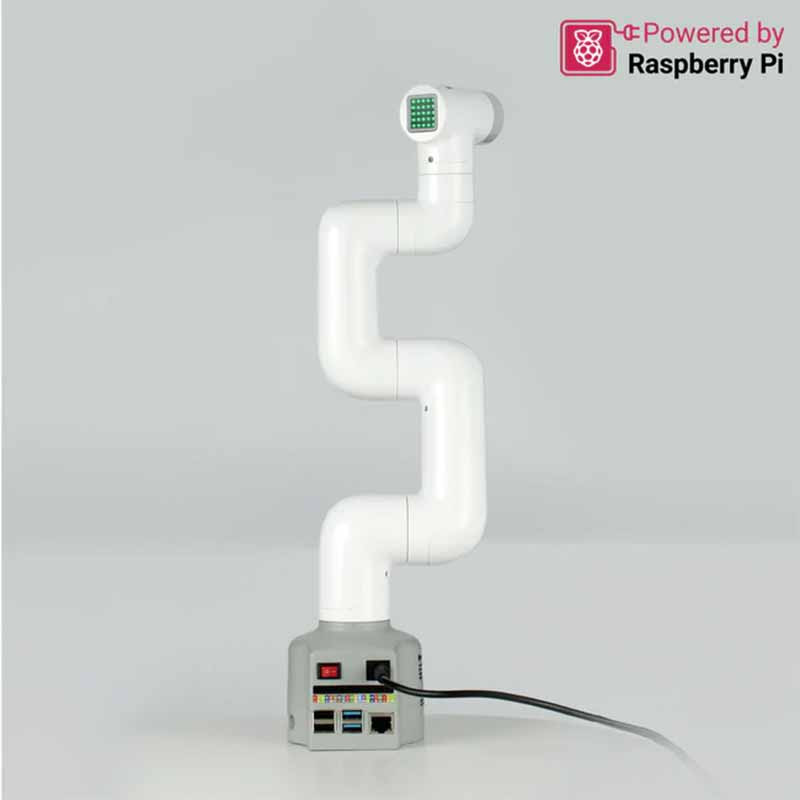
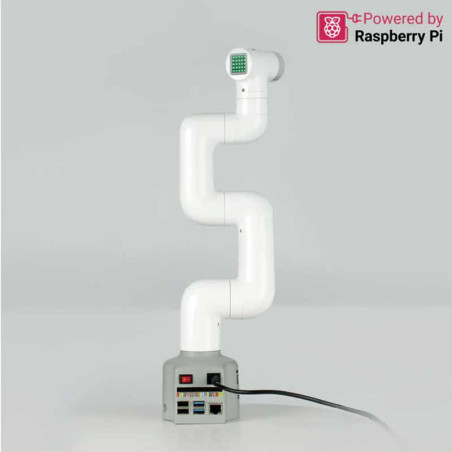
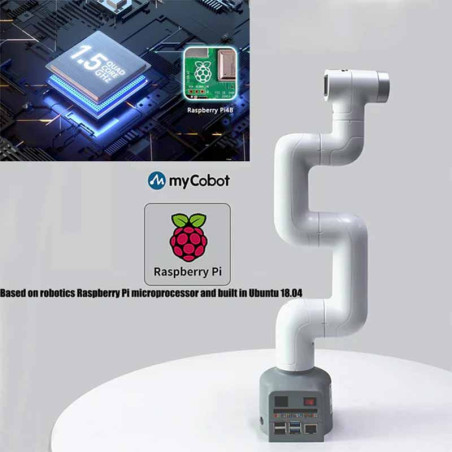
Elephant Robotics myCobot 280 Raspberry Pi 4GB RAM is recognized as the world's smallest and lightest 6-axis collaborative robot (cobot). This model represents a strategic collaboration between Elephant Robotics and the Raspberry Pi Foundation, resulting in an "all-in-one" robotic platform. Unlike other robotic arms that require an external computer for processing, the myCobot 280 Pi features an integrated Raspberry Pi 4B microprocessor, turning it into a standalone computer capable of executing complex AI tasks, image processing, and automation.
The 4GB RAM allows for smooth operation of the Ubuntu OS alongside multiple ROS nodes, real-time video processing algorithms, and local databases without performance degradation.
Advantages of the 4GB RAM Variant:
Multitasking: Can simultaneously run the robot server, a 1080p webcam stream, and an object recognition script without running out of memory.
Stability: Prevents "Out of Memory" (OOM) crashes common in lower-RAM versions when using complex graphical interfaces.
Video Processing: Ideal for "Eye-to-Hand" or "Eye-in-Hand" projects where frame rate and processing speed are critical.
Primary Applications
STEM Education: Learning robotics, kinematics, and programming in an interactive way.
Research and Development: Prototyping small assembly lines or testing AI algorithms.
Laboratory Automation: Handling test tubes or small samples.
Art and Creativity: Programming the robot to paint, draw, or perform repetitive movements for video filming.
Technical Specifications
Robotic Arm
Degrees of Freedom (DoF): 6 independent axes.
Maximum Working Radius (Reach): 280 mm.
Maximum Payload: 250 g.
Precision and Repeatability: +/- 0.5 mm.
Total Weight: 850 g (extremely portable).
Construction Material: High-strength industrial nylon.
Movement Speed: Up to 165 degrees per second (per axis).
Servo Motors: 6 intelligent motors with integrated feedback for position, temperature, and torque.
Power Supply: DC 12V, 5A.
Operating Temperature: Between -5 and 45 degrees Celsius.
Integrated Control Unit
Processor (CPU): Broadcom BCM2711, Quad-core Cortex-A72 at 1.5GHz (64-bit).
RAM Memory: 4 GB LPDDR4 (essential for multitasking and heavy AI processing).
Operating System: Pre-installed Ubuntu Mate 20.04.
Storage: MicroSD card included (typically 32GB or 64GB with the system image).
Connectivity:
Dual-band WiFi 2.4GHz / 5.0GHz.
Bluetooth 5.0 (BLE).
2 x USB 3.0 ports (high-speed data transfer).
2 x USB 2.0 ports.
2 x Micro-HDMI (4K video output).
1 x Gigabit Ethernet.
40 x GPIO pins accessible for electronic extensions.
Motion Control and Sensors
Servo Motors: High-precision serial bus servos.
Feedback: Real-time monitoring for each joint's angle, load, and motor temperature.
Secondary Controller: Integrated ESP32 microcontroller to ensure low latency between software commands and mechanical execution.
Software Ecosystem and Programming
Visual Programming: myBlockly (for rapid learning and prototyping).
Text-based Programming:
Python (via the pymycobot API).
C++ and C# (through dedicated libraries).
Robotic Platforms:
ROS 1 / ROS 2: Full integration for simulation and distributed control.
MoveIt: Complex trajectory planning.
RViz: 3D digital-twin visualization.
AI Integration: Native support for OpenCV, TensorFlow, and PyTorch (with significantly improved performance due to the 4GB RAM).
Design and Extensibility
Base: Equipped with mounting holes and LEGO compatibility, allowing it to be fixed on various surfaces or mobile platforms.
End-effector: Features a flange with communication pins and standard mounting holes. Various accessories can be attached, such as:
Adaptive or pneumatic grippers.
Suction cups for vacuum lifting.
Holders for cameras or writing instruments.
Status Screen: While the base is powered by Raspberry Pi, the arm's head features a small LED module or interface to display the robot's status.
Specific References
No customer reviews for the moment.